Let’s work together.
Grounded support for workforce and leadership systems under pressure
You can already see where it’s wobbling.
Your middle managers are delivering. But the permission-seeking loops are multiplying. Decisions that should sit with them keep floating back up. Good operators are going quieter. Not leaving yet. Just narrowing.
And you’re spending more time in conversations you shouldn’t be in, mediating, reassuring, re-deciding delegated work, because the layer below doesn’t have what it needs to hold without you.
Nothing has gone wrong yet. That is precisely what makes the decision hard.
The risk isn’t that the program stops working.
The risk is being the person who saw it coming, kept compensating, and is later asked why nothing structural changed before pressure arrived.
This work is for leaders carrying accountability without full authority.
Heads of HR and People and Culture responsible for program outcomes they cannot always enforce.
Program and change leaders running complex initiatives across multiple stakeholders with no clean lines of authority.
CEOs and deputy CEOs absorbing escalation load that should be sitting lower in the organisation.
SME executives holding workforce systems directly, often without a team behind them.
If that is you, the work starts with one question
What is holding by design, and what is only holding because people keep compensating?
Ways to work together.
-
✺
Anti-Fizzle Survivability Check
A bounded diagnostic for when you need clarity before you commit to anything. Used when programs feel fragile in practice even if they look acceptable on paper. The output is decision-ready insight, not a prescribed solution
-
✺
Working directly with CEOs and senior leaders
Working directly with CEOs and senior leaders in aged care and community services on the people and leadership infrastructure their organisations need during periods of growth or significant change.
-
✺
Fractional Program Management and Support
Practical delivery support for complex workforce and reform initiatives. Used when programs stall after approval, decisions are delayed or diluted, or follow-through relies on informal effort rather than structure.
-
✺
Ember Operating Rhythm
A structured installation for organisations that need the middle layer to hold under sustained pressure. Builds decision containment, authority boundaries, and follow-through cadence over six months.
The discovery call exists for one reason

To make sure any engagement reduces your exposure rather than adding to it.
It is used to understand what is currently being held by goodwill, confirm the safest and most useful entry point, and avoid committing to work the organisation cannot support internally.
If nothing needs to change right now, that is a useful answer too.
Featured Product
Featured Product
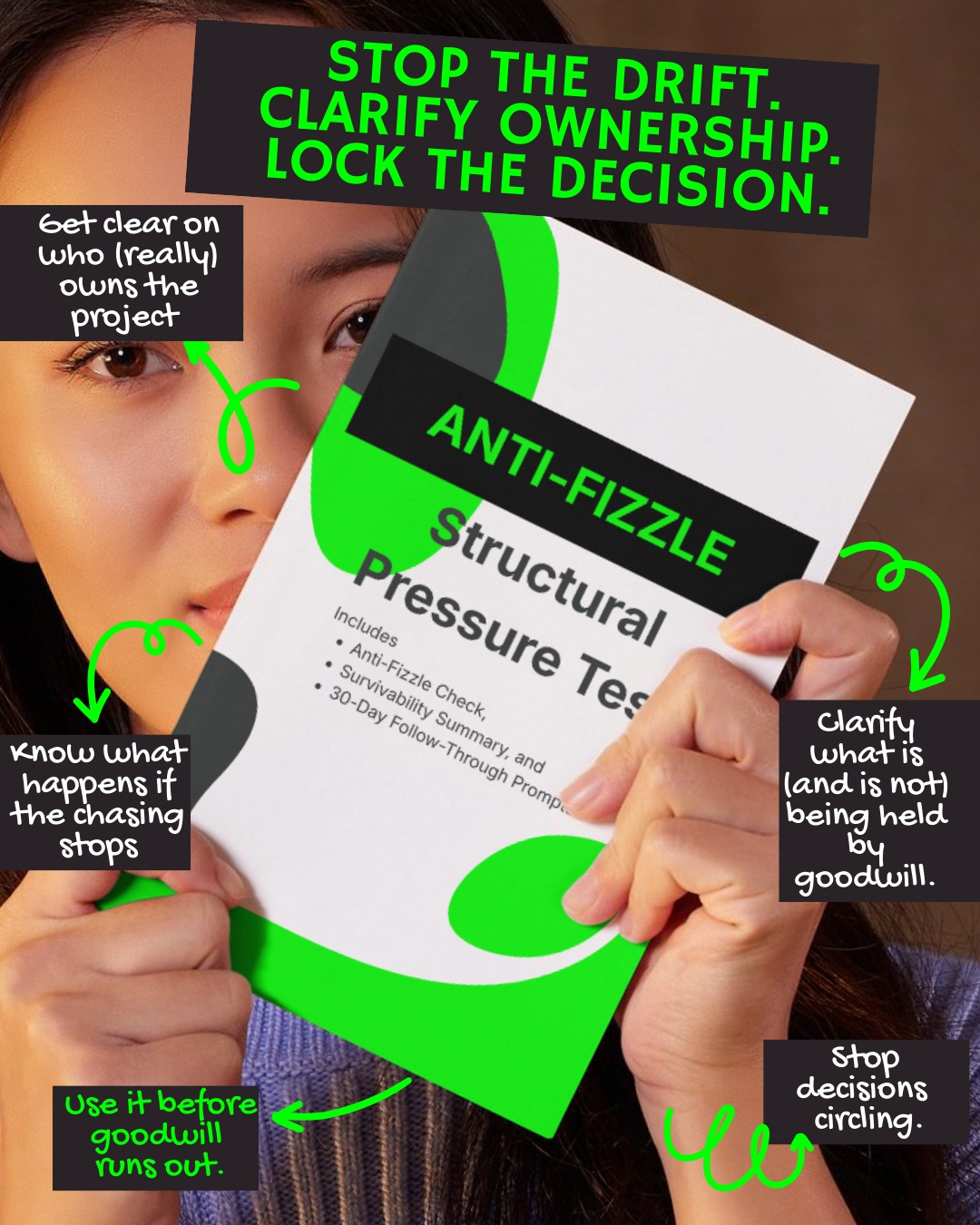
A one-sitting decision-support tool for people and leadership programs that are starting to stall.
Approved. Launched. Reporting.
On paper it looks active.
In practice, it isn’t holding.
Participation is slipping.
Progress depends on chasing.
Informal load is keeping it afloat.
Decisions are circulating, not landing.
This is not an engagement problem.
It’s a survivability gap, where goodwill becomes infrastructure and risk sits with individuals.
Make a clear call before goodwill is exhausted and exposure escalates.
Includes
AntiFizzle Survivability Check workbook, a structured diagnostic to identify where effort is standing in for structure.
Survivability Summary Report, turns your answers into an accountable decision record, showing what is unowned or goodwill-dependent so risks are visible, decisions can land, and the program can hold under pressure.
30-day follow-through prompts that keeps the decision in view, prompts the next action, and helps prevent informal load creeping back in, like a coach in your inbox.
Some organisations know exactly what support they need.
Others can see pressure building, but want clarity before committing to any engagement.
The Anti-Fizzle Survivability Check exists to help you decide safely what (if anything) should happen next.
FAQ
How does Hyphae Network work with organisations?
Through a small number of clearly defined engagement types. A diagnostic to assess what is actually holding, design sprints to rebuild structure, fractional program management support, and Ember Operating Rhythm for sustained installation work. Every engagement is bounded and scoped before it starts.
What does it cost?
The Anti-Fizzle Survivability Check is a fixed-price entry point. Sparkline tickets are $450 per person. Fractional support and the Ember Operating Rhythm are scoped to the engagement. Book a discovery call to discuss.
How quickly can work start?
Depends on the engagement type. The Survivability Check can move quickly. Fractional and Ember Operating Rhythm engagements require a scoping conversation first. If something is urgent, say so on the call.
What if we’re not sure what we need?
That is exactly what the discovery call is for. You do not need to arrive with a brief. Book a discovery call →