If you stopped chasing, would your programs and projects hold?
If you redirected your attention to a higher-risk issue, would it keep moving?
Anti-Fizzle Survivability Check
A private 45-minute structural pressure test for people and leadership programs.
$97 one-time purchase
Reusable. No subscription. Immediate access.
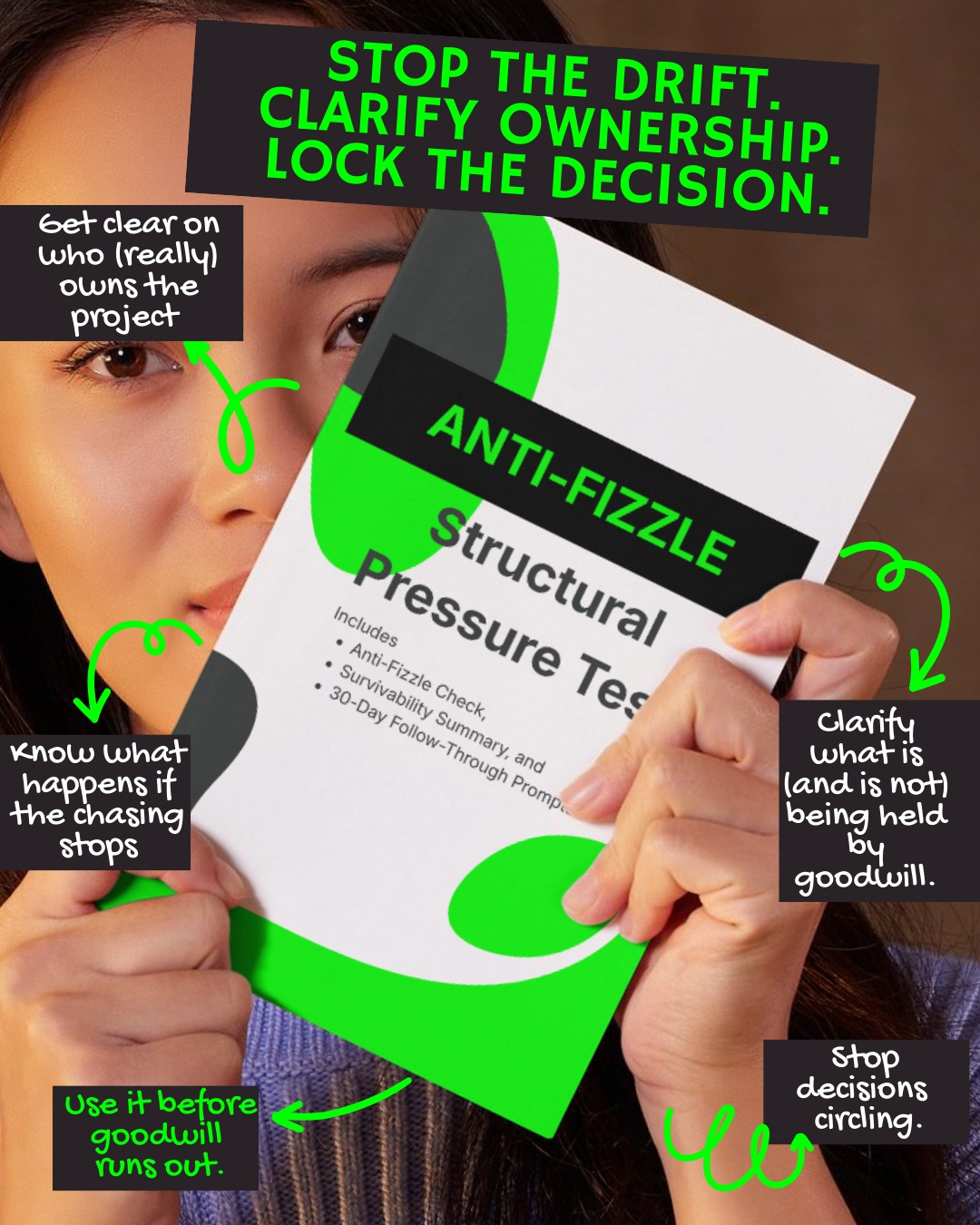
A one-sitting decision-support tool for people and leadership programs that are starting to stall.
Approved. Launched. Reporting.
On paper it looks active.
In practice, it isn’t holding.
Participation is slipping.
Progress depends on chasing.
Informal load is keeping it afloat.
Decisions are circulating, not landing.
This is not an engagement problem.
It’s a survivability gap, where goodwill becomes infrastructure and risk sits with individuals.
Make a clear call before goodwill is exhausted and exposure escalates.
Includes
AntiFizzle Survivability Check workbook, a structured diagnostic to identify where effort is standing in for structure.
Survivability Summary Report, turns your answers into an accountable decision record, showing what is unowned or goodwill-dependent so risks are visible, decisions can land, and the program can hold under pressure.
30-day follow-through prompts that keeps the decision in view, prompts the next action, and helps prevent informal load creeping back in, like a coach in your inbox.

You don’t need another engagement push.
Right now your program is:
✔️ Approved.
✔️ Funded.
✔️ Reporting.
✔️ Participation is logged.
✔️ Sessions are running.
✔️ Updates are going upward.
Technically, none of that is false … but you
… are still uneasy defending it.
… hesitate when someone asks if it’s embedded.
… know it depends on you more than it should.
… are carrying more of it than the structure is.
But underneath, you can feel the instability.
managers are negotiating protected time away.
you are sending reminders that shouldn’t be necessary.
and you are quietly over-functioning.
You are absorbing the gap.
That’s not a motivation issue. It’s not a culture issue.
It’s a structural exposure problem, which means burnout becomes the cost of keeping it alive.
This is what exposure looks like
When goodwill becomes infrastructure, risk sits with individuals.
People like you.
Participation dropping the moment chasing which means the program survives on reminders, not commitment.
Informal work keeps things moving
Ownership is blurred across HR, operations, and exec
Reporting shows activity, not viability so risk stays hidden until it escalates
You are hesitating when asked to defend the current design under scrutiny
What the Anti-Fizzle Check does
This is not training. Not a workshop. Not a redesign sprint.
It is a structured decision check you complete privately in one sitting (45–60 minutes).
It forces clarity on:
What is structurally protected
What relies on informal effort
Where authority does not match accountability
What would fail under turnover, restructure, or scrutiny
Whether to stabilise, redesign, pause, or stop
The workbook is the mechanism.
The outcome is decision containment.
You stop guessing whether it will hold and start building trust.
A one-sitting decision-support tool for people and leadership programs that are starting to stall.
Approved. Launched. Reporting.
On paper it looks active.
In practice, it isn’t holding.
Participation is slipping.
Progress depends on chasing.
Informal load is keeping it afloat.
Decisions are circulating, not landing.
This is not an engagement problem.
It’s a survivability gap, where goodwill becomes infrastructure and risk sits with individuals.
Make a clear call before goodwill is exhausted and exposure escalates.
Includes
AntiFizzle Survivability Check workbook, a structured diagnostic to identify where effort is standing in for structure.
Survivability Summary Report, turns your answers into an accountable decision record, showing what is unowned or goodwill-dependent so risks are visible, decisions can land, and the program can hold under pressure.
30-day follow-through prompts that keeps the decision in view, prompts the next action, and helps prevent informal load creeping back in, like a coach in your inbox.
What changes after you run it?
You walk away with:
A clear articulation of what is actually unstable, in plain language
Ownership that is written down and defensible
A decision you can stand behind
A short list of structural fixes that materially improve survivability
Fewer repeat meetings and less chasing
A program that can survive handover
Continuity becomes structural, not personal.
Why this matters
When these programs drift, the cost compounds quietly:
Champions burn out or disengage
Trust in development pathways erodes
HR load increases through grievances and psychosocial strain
Replacement and onboarding costs rise
The next initiative starts with lower belief
Programs rarely fail loudly. They fracture.
Knowledge walks out the door.
Credibility drops.
And the cycle repeats.
This tool exists to interrupt that cycle early.
What you get
Anti-Fizzle Survivability Check
Structured, fillable workbook. Reusable across programs.
One-Page Survivability Summary
Plain-language articulation of unowned risk and authority gaps.
30-Day Follow-Through Support
Guidance to lock decisions and prevent informal load creeping back in.
No subscription | No recurring fee
Use it whenever a program starts to wobble.
Designed for privacy
You complete this independently.
❌ No facilitation required.
❌ No reporting obligation.
❌ No escalation built in.
You decide what to do with the outcome.
The cost of delay is always higher.
🏃🏻Run it before you are defending something you already knew was fragile.
🏃🏼♀️Run it before burnout becomes the price of caring.
🏃🏽♂️Run it before you quietly absorb another quarter of structural risk.
Investment
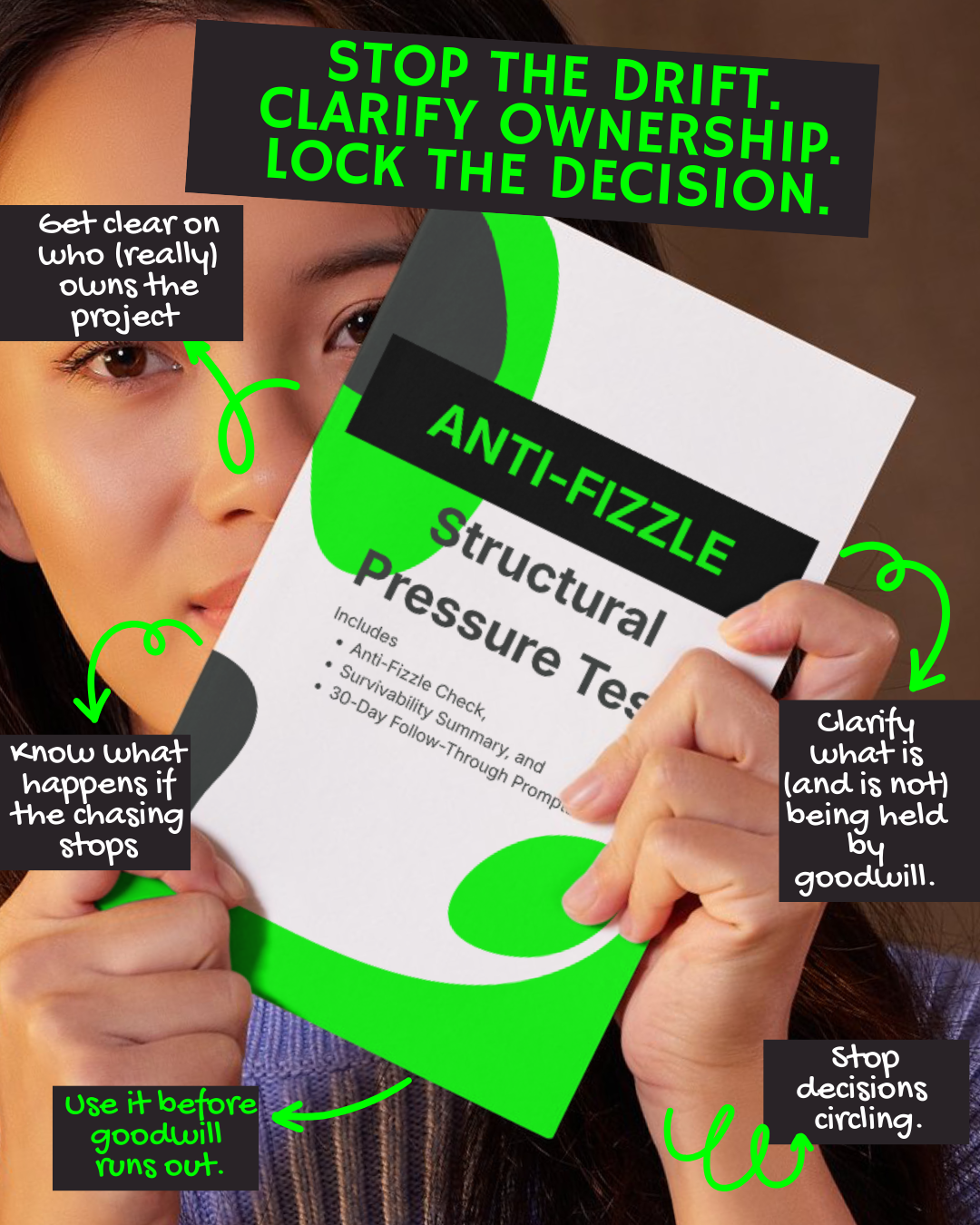
A one-sitting decision-support tool for people and leadership programs that are starting to stall.
Approved. Launched. Reporting.
On paper it looks active.
In practice, it isn’t holding.
Participation is slipping.
Progress depends on chasing.
Informal load is keeping it afloat.
Decisions are circulating, not landing.
This is not an engagement problem.
It’s a survivability gap, where goodwill becomes infrastructure and risk sits with individuals.
Make a clear call before goodwill is exhausted and exposure escalates.
Includes
AntiFizzle Survivability Check workbook, a structured diagnostic to identify where effort is standing in for structure.
Survivability Summary Report, turns your answers into an accountable decision record, showing what is unowned or goodwill-dependent so risks are visible, decisions can land, and the program can hold under pressure.
30-day follow-through prompts that keeps the decision in view, prompts the next action, and helps prevent informal load creeping back in, like a coach in your inbox.